
Atlantic Resident Lookup Records
One name can appear in several Atlantic County systems for very different reasons. A parcel record can connect an owner to a piece of land. A court jacket can identify a party to a case. An estate file can connect a decedent, executor, and next of kin. None is a master list of current residents. Begin with the record that matches the fact already known, then keep the source date beside each result. That approach helps separate a person from a same-named owner, litigant, or business contact.
| Record | What It Confirms | Where | Access |
|---|---|---|---|
| Assessment property record | Owner of record, situs parcel, block and lot, sales clues | Atlantic Property Assessment Search Hub | Public search; protected addresses may be withheld |
| Recorded deed or mortgage | Parties, legal description, recording date, consideration, related filing | Atlantic Clerk SearchNG | Free index; images depend on scan coverage |
| Voter status | Status and matched voter context | NJ Voter Information Portal | Exact-name status check; protected fields excluded |
| Court case jacket | Docket, parties, case type, attorneys, events, and disposition clues | NJ Courts Find a Case | Public docket data; some files are restricted |
| Estate or vital record | Family, death, probate, or event details | Atlantic Surrogate or NJ Vital Statistics | Rules differ by record and requester |
Use the assessment hub when the question is ownership or parcel context. Use SearchNG when a recorded transfer, mortgage, map, or legal description may anchor the name. A voter status check is narrower, while courts, probate, and vital records can help distinguish family or event history. The Atlantic street directory has the fuller address-first chain when the task shifts from one person to a whole street.
Atlantic Clerk Name Variants
The Clerk’s Official Records Public Search, also called SearchNG, offers party-name, second-party, document-group, date, book-and-page, file-number, consideration, town, lot, block, and map-number routes. Its instructions say a party-name search automatically wildcards the end of a term. More Names accepts additional names, ALL or ANY logic changes the name match, and a second party supports a two-party search. These controls make the recorded index useful for testing a name against a municipality or parcel instead of treating a broad hit as proof.
Search the full spelling first, then test a spaced, hyphenated, initialed, married, or abbreviated form. The Clerk explicitly warns that names can be indexed inconsistently. Open the detail beside the hit list and use linked documents to follow related instruments without losing the search. The online index has free guest access. Images are stated as viewable from March 1, 2000, with older material added through back-scanning. If an older index hit has no image, use the Clerk’s records room, State Archives microfilm, or a FamilySearch collection instead of assuming the instrument is missing.
Note: A recording connects a person or entity to a document, not necessarily to a present home address or current identity.
Atlantic Resident Status Checks
New Jersey identifies the statewide “Am I Registered?” service as the voter-status route. Atlantic County guidance adds an important local match rule: the name must match the county record. McDonald may be indexed as Mc Donald, a marriage name may differ, a middle initial can prevent a match, and a nickname may not match the formal record. A no-match therefore is a prompt to test the official spelling or contact the election office, not proof that a person is absent from Atlantic County.
The NJ Voter Information Portal is the official status-search source used for this check.
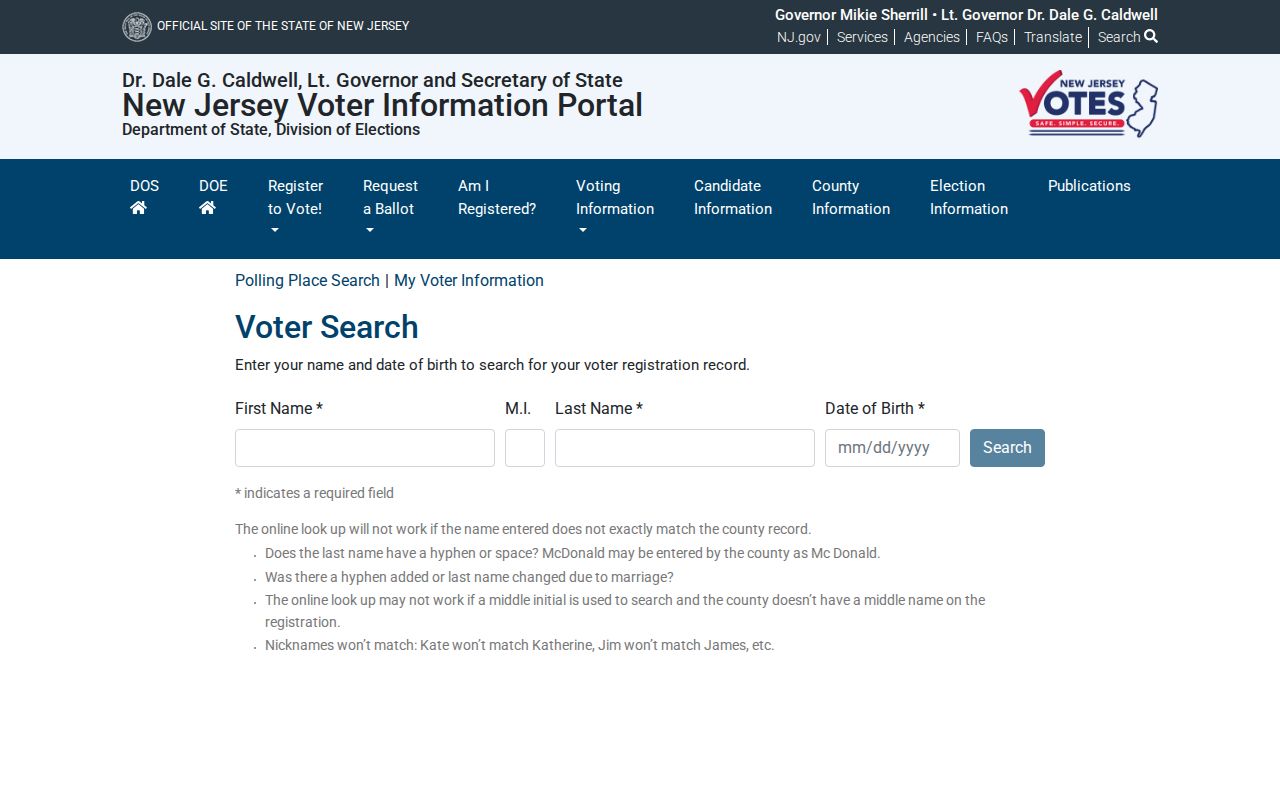
The portal image is a reminder to use voter results as one dated confirmation only. Under N.J.S.A. 19:31-39, public list access does not include signatures, and Daniel’s Law can keep a covered person’s home address out of disclosure. Registration status also cannot show every person connected with an address. Someone may be unregistered, inactive, moved, or protected.
Atlantic Case Jackets for Residents
The NJ Courts Find a Case landing page separates civil and foreclosure case jackets, criminal cases, criminal judgments, judgment liens, tax cases, and municipal matters. The Atlantic/Cape May Vicinage handles Superior Court matters for this area, but a party in a case may live elsewhere. A case that names an Atlantic parcel is also not a current-residence record. Compare case type, venue, dates, party role, attorney, and disposition before using a case as an identity clue.
For the public Case Jacket party route, the official training material documents an individual or business choice, last and first name fields, an optional middle initial, a case-type context, and CAPTCHA. Two-character name searches are exact only; three or more characters in either name broaden the range. The public result can identify the docket and parties, but it does not supply images of filed documents. Sealed, expunged, juvenile, and other Rule 1:38 material remains outside public access. Older or unavailable material may require a courthouse terminal, a clerk contact, or the Judiciary’s electronic records request.
| Case-jacket field | What it can show |
|---|---|
| Case or docket number | The court’s identifier and venue for the matter. |
| Case type or division | Whether the matter is civil, criminal, family, tax, judgment, foreclosure, or another public route. |
| Party names and status | Named litigants and a status such as active, defaulted, or settled where documented. |
| Attorneys and events | Representatives, filings, orders, scheduled proceedings, and noted dispositions. |
Verify an Atlantic Resident
Verification works when two independent records converge on the same person and place. A property owner is not automatically an occupant, and a license or business filing can use a commercial or agent address. Keep a simple comparison grid with the exact name spelling, middle initial, event or record date, municipality, parcel or block and lot, associated relative or business, and the source date. That written check is especially useful when a common name appears in a deed and a court docket.
- Start with the known full name and an approximate municipality or parcel. Search the Clerk’s party index with spelling variants.
- Search the property hub by owner name or property address. Compare the municipality, block and lot, sale details, and any displayed mailing clue without calling it proof of occupancy.
- Use the voter status service only for a matching status check. Test spacing, hyphens, middle initials, and former names if the first search fails.
- Check a court docket, probate file, obituary, historical directory, or vital index for a second event-based connection. Ask the custodian to explain a field or correct an error.
- Docket
- A court’s case number and event trail. It identifies a proceeding, not a person’s current address.
- Index and image
- An index is a searchable list of record details. An image is the scanned document, which can have different availability and access limits.
- Certified copy
- A copy issued by the custodian with official certification. New Jersey vital records require eligibility and identification for certified copies.
Atlantic Resident Lookup Vital Limits
Vital records are not a general open-name directory. For an Atlantic County event, the local registrar where the event occurred and the New Jersey Department of Health divide custody. State records begin with births in 1925 and marriages and deaths in 1951, while the State Archives carries older historical ranges. A genealogical route is available for deceased birth records older than 80 years through 1925, marriages older than 50 years through 1951, and deaths older than 40 years through 1951.
The state distinguishes an informational certification from a certified copy. Certified copies require the qualifying relationship and identification described by NJDOH. State genealogy orders have a documented initial fee and mail processing window, while local fees and timing vary. For a birth-parent or adoption question, use the confidential REG-36 and REG-41 state processes rather than trying to recreate the answer from public records. Probate, cemetery, church, newspaper, and historical-directory material can be useful alternatives when a vital record is restricted.
Atlantic License Cross-Checks
A professional or business record can confirm a credential, entity name, role, or status. It should not be treated as a residence record. New Jersey Consumer Affairs offers real-time verification through separate Person Search and Business Search paths, with a license type selected after the person or business route. Registered agents, officers, licensees, and UCC debtors may use a commercial or agent address. Compare the result with a deed, docket, probate file, or obituary before relying on it as an identity match.
New Jersey Consumer Affairs License Verification provides the official person and business verification choices.
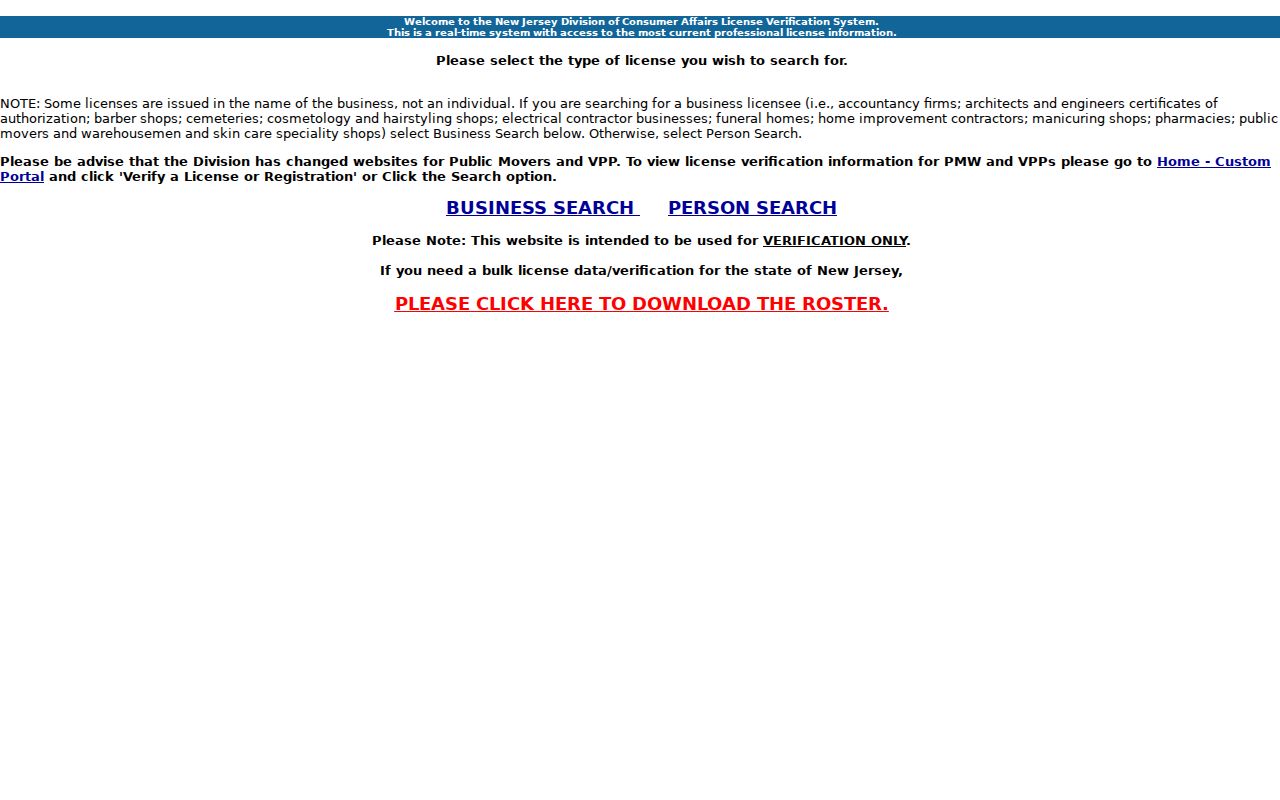
Use the result to record the name, license category, status, and date shown by the official service. If the record is business-named, use the Business Search route. If the issue is a company or trade name, the state business status service and Atlantic County Clerk trade-name records are separate sources with their own document rules.
Atlantic Estate Names and Notices
The Atlantic Surrogate records wills and estate-administration documents. The county states that completed probate files are open for public inspection. An estate may identify a decedent, executor or administrator, beneficiaries or next of kin, and probate dates. Notice and proof-of-mailing material can preserve known addresses, while an unknown address may lead to newspaper publication. Those facts can help connect an heir or family relationship, but an estate file alone does not prove ownership of a particular parcel.
For a trail that begins with a deceased owner, compare probate material with the recorded transfer, tax map, and property record. The Surrogate is not an OPRA route, so contact that office directly for its public-inspection process. Historical context can also come from the Atlantic County Library System, the Atlantic County Historical Society, and the State Archives. Use yearbooks and directories to test an old identity, not to assert a current address.
Note: An estate notice can be a family-history lead, but the recorded deed and legal description are stronger evidence of a parcel transfer.
Atlantic Resident Lookup Privacy
New Jersey Open Public Records Act (OPRA) requests seek existing government records from the correct custodian. They do not require an agency to create a new people list. Daniel’s Law can redact covered home addresses and unpublished telephone numbers from government records and internet postings. The New Jersey Address Confidentiality Program gives eligible survivors a substitute address for new state and local government records. A protected or missing address should be respected, not treated as a gap to work around.
To correct a factual error, contact the office that created the record: the assessor or municipal clerk for property fields, the County Clerk for recorded-instrument indexing, the Superintendent for voter records, NJDOH or a local registrar for vital records, and the court clerk for case data. Private search services may combine stale or same-name data, and removing a private listing does not change a public source record.
Lawful use. Use Atlantic County records for personal, family-history, estate, civic, or safety questions. Do not use a result to stalk, harass, threaten, intimidate, or expose a protected person.