
Atlantic Previous Residents by Era
A backward Atlantic address search works best when each source is assigned a time period and a job. Start with the current Atlantic parcel, then use the deed index to move from owner to owner. Directories and census schedules add the household layer, while probate and newspapers help explain a death, estate transfer, address change, or long gap. Atlantic availability is uneven, so the table separates an index or catalog finding from a claim that every document image is online.
| Source | Years It Covers | Where Held | What It Shows |
|---|---|---|---|
| Atlantic Clerk public index and images | Images stated from 2000 forward; older scans added | Clerk SearchNG and records room | Recorded parties, legal description, dates, book/page, and linked documents |
| Atlantic Clerk index books | All 414 books reported completed; earliest year not stated | Clerk historical search material | Historical index depth, with image availability checked item by item |
| Atlantic deeds and mortgages | Deeds through 1900; mortgages through 1850 | New Jersey State Archives | Older title and encumbrance clues |
| Atlantic City and shore directories | 1889–1907 Gopsill listed; separate runs into the 1930s | State Library, libraries, and catalog routes | Year-specific occupant, address, and business clues |
| State and federal censuses | NJ 1855–1915; released federal 1850–1880 and 1900–1940 | State Archives, library microfilm, and approved catalog collections | Household context, subject to year and address limitations |
For a recent Atlantic transfer, begin with the assessment record and Clerk index. For an older Atlantic household question, shift sooner to the State Archives, local repositories, and dated directory titles. Do not treat a current online image cutoff as the beginning of the county's recorded history.
Normalize an Atlantic Address First
Write down two versions of the Atlantic location before opening a search: the original form exactly as it appears on a paper, and a normalized form with street number, directional, street type, municipality, ZIP or post-office label, and block/lot if known. This protects the old Atlantic wording while giving county systems a consistent query. It is especially important in Atlantic County because Mays Landing is a community in Hamilton Township, and coastal directory titles can use Atlantic City, Chelsea, South Atlantic City, Longport, Ventnor, Margate, or Pleasantville in different combinations.
Use the Atlantic County Property Assessment Search Hub to search property or address, town, owner name, and B.L.Q., meaning the block, lot, and qualification-style parcel filter. The Atlantic Board of Taxation says its list books contain owner names, addresses, block and lot numbers, assessments, and sales data. A mailing address may be an agent, business, post-office box, or other correspondence location, so it is not proof of who occupied the parcel.
Note: A current ZIP or post-office label is not proof of the historic municipality or old boundary for an Atlantic address.
Atlantic Previous Residents and Deed Chains
After the Atlantic parcel is fixed, use the Atlantic County Clerk Official Records Public Search to build the title sequence. Search the current owner as a grantee, using exact and variant spellings, then narrow by municipality, document group or type, and date. Open the deed through its book/page or file-number result. Record the grantor, grantee, consideration, legal description, municipality, block/lot, recording date, book/page or file number, and any earlier Atlantic instrument cited in the document.
- Find the current property record, then record the municipality and block/lot or other parcel identifier before searching names.
- Search the current owner as grantee in SearchNG and compare the deed's legal description to the parcel.
- Take the seller named on that deed and search that person as grantor to find the preceding transfer.
- Repeat the comparison at each link. The legal description, not a similar-looking street address, controls the connection.
- When the web trail ends, move to the Clerk records room, index books, maps, State Archives microfilm, or a FamilySearch catalog route rather than assuming the chain has ended.
- Grantor
- The person or entity transferring an interest in property in a recorded document.
- Grantee
- The person or entity receiving that interest. A grantee in one deed may become the grantor in the next earlier search step.
- Chain of title
- The sequence of recorded transfers tied together by a consistent legal description or parcel identifier.
- Legal description
- The recorded municipality, lot, block, map, or tract wording that identifies land more reliably than a street address alone.
Atlantic SearchNG Linked Records
The Atlantic Clerk's instructions describe party-name, second-party, document-type, date-range, book/page, Clerk's-file-number, consideration, legal town, lot, block, and map-number searches. Party-name searching automatically adds a trailing wildcard, More Names supports additional names, and two-party searching can require both parties. Search all reasonable Atlantic spelling variants. The Clerk warns that proper names may appear inconsistently in the index.
The Atlantic instruction route also documents Include Linked Documents. A mortgage may lead to an assignment or satisfaction, and a deed or map can reveal a prior book/page or legal-description clue. Treat these items as timeline corroboration, not as proof that a named party lived at the address. Foreclosure filings, liens, tax-sale certificates, and releases may identify an Atlantic event without identifying an occupant.
The Atlantic County Clerk's SearchNG portal is shown below.
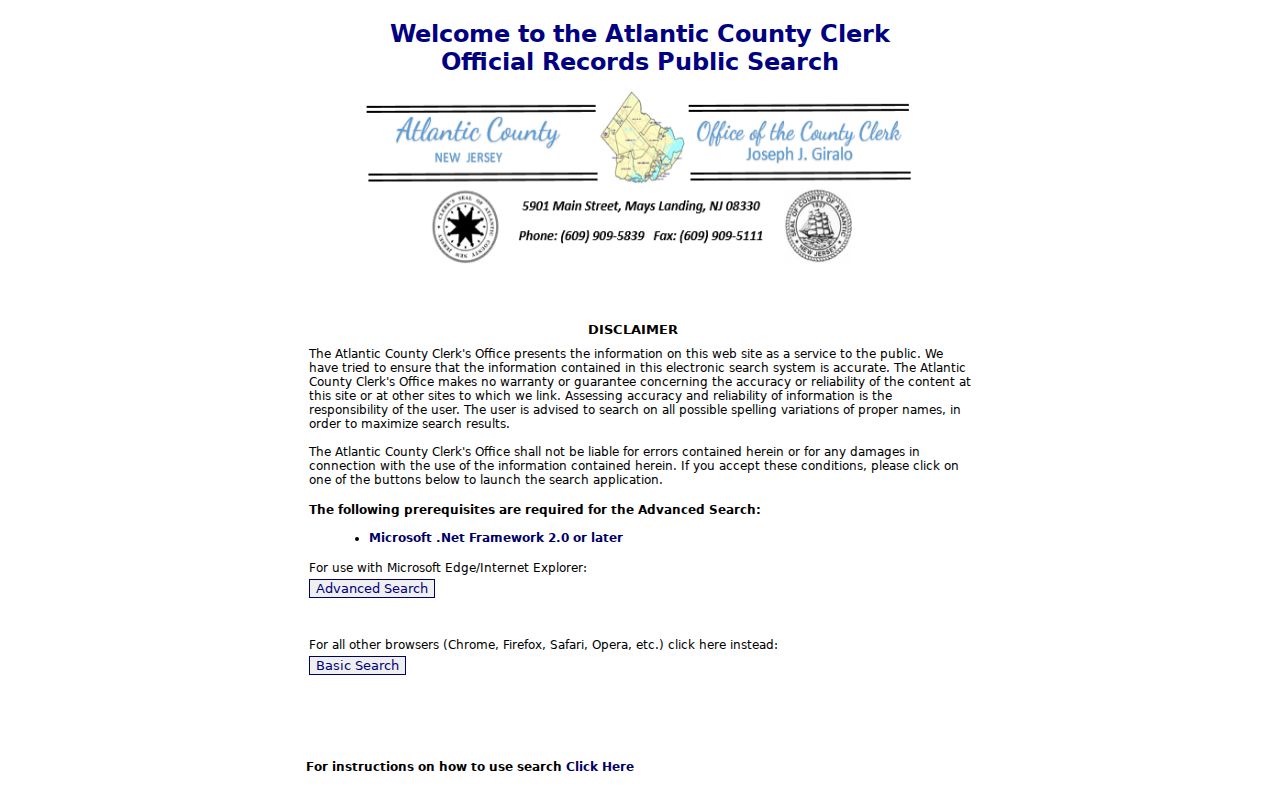
The public index provides a place to preserve exact party names and document references before an older record requires a counter or archive visit.
Atlantic Previous Residents Before 2000
Atlantic SearchNG states that document images beginning March 1, 2000 are viewable, while older images are being back-scanned. That is an image-access statement, not an Atlantic County history start date. The Clerk reports completed preservation work for more than 9,500 recorded maps and tax maps and all 414 index books, while deed-book scanning continues. Test Atlantic image access for the specific document and write down the missing access channel when only the index can be found.
The New Jersey State Archives genealogy collections provide the documented older fallback: Atlantic County deeds through 1900, mortgages through 1850, surrogate books to 1900, wills and inventories, Chancery files, state censuses, naturalization, military, and newspapers. Catalog or reference staff can help locate the needed volume and page when an online image is unavailable. The State Archives layer supports a long historical chain but does not replace a careful legal-description comparison.
The State Archives genealogy search route is shown below.
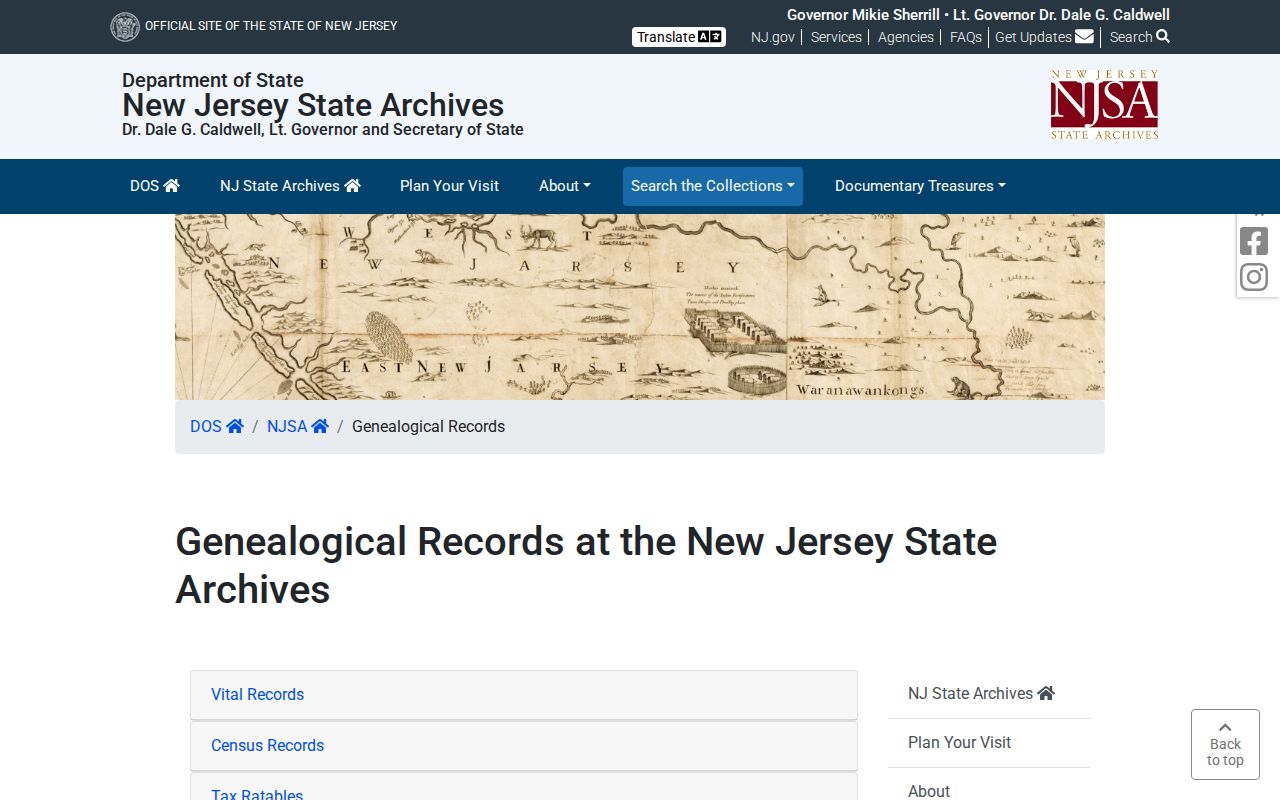
Use the archive catalog or reference process to carry a documented gap backward, rather than filling the gap with an assumed owner.
For local Atlantic help, the ACLS Resource Center offers reference staff, Jerseyana and genealogy material, census microfilm, directories, local-government material, and digitized South Jersey newspapers. The Atlantic County Historical Society library adds family files, directories, local newspapers, church and cemetery records, yearbooks, photographs, manuscripts, and oral histories. Ask either repository about the exact address, former municipality, surname, and year; staff support and local holdings do not guarantee a complete title search.
Atlantic Previous Residents in Census
Atlantic ownership is only half of an address history. To identify Atlantic past residents, pair the confirmed parcel or street with dated city directories and census records. The local directory shelves, titles, and access limits are described on the Atlantic city directory page. An Atlantic directory can place an occupant or business at an address for a stated year; a census can add household context. Neither should be treated as a substitute for the other, and neither alone proves ownership.
- Choose the nearest available directory year and copy the name form, address, municipality title, page, and any historical occupation or household clue.
- Compare the next available title instead of assuming that every year was published or preserved.
- Pair the directory date with a released federal schedule or New Jersey state census, then compare name variants and household details.
- Use the 1885 New Jersey state census, 1889/1891 directories, newspapers, deeds, and church or cemetery material across the lost 1890 federal census.
- Confirm any same-name match with a second anchor such as a deed parcel, tax map, probate relationship, or exact address.
New Jersey state censuses were taken in years ending in five from 1855 through 1915, though 1855, 1865, and 1875 are incomplete. Atlantic/Passaic 1885 has a searchable database, while 1885, 1905, and 1915 indexes are available through FamilySearch. Released federal schedules provide another Atlantic household check for 1850–1880 and 1900–1940, subject to the 72-year release rule.
Atlantic Previous Residents and Obituaries
Atlantic newspapers and probate files often close an address trail when a person leaves a directory or an owner dies. The Atlantic County Historical Society holds local newspapers for 1859–1868 and 1905–1955, while ACLS lists digitized South Jersey papers from the 1860s, New York Times microfilm from 1851, and Atlantic City Press microfilm from 1981. Search an Atlantic surname with the address, municipality, church, business, or street spelling, then retain the publication date and exact wording.
An Atlantic obituary can identify relatives, funeral home, cemetery, church, executor, or an address if printed. The Atlantic Surrogate says completed probate files are open for public inspection. A will, notice, short certificate, inventory, or recorded transfer may connect a deceased person to an Atlantic estate or heir, but probate alone does not prove that the decedent owned a particular parcel. Compare it with a deed, tax map, or legal description.
Atlantic Address Changes and Gaps
Atlantic address continuity is the most common false break in this work. Street names, suffixes, numbers, post-office labels, municipal boundaries, and parcel descriptions can change independently. Atlantic County research did not locate an official renumbering schedule, a single historical address-conversion table, or a countywide house-history database. Test a suspected Atlantic change against municipal clerk or assessor records, historic maps, directory reverse sections, newspapers, tax maps, and the deed's municipality and block/lot.
Atlantic County GIS and the tax-map archive help orient a parcel and find the correct map sheet, but the county says the GIS data are secondary products and not survey-grade legal-boundary material. Municipal construction or code files may date an Atlantic addition, permit, inspection, or address change. No countywide permit portal or uniform retention schedule was located, so request existing address-keyed records from the municipality that governs the situs address. Utility customer accounts are not assumed public.
Note: Treat an unscanned image, a missing directory year, or an unconfirmed street change as a documented research gap, not evidence of a missing person.
Atlantic Previous Residents and Lawful Use
Atlantic house-history and family-history work should distinguish a past record from a present claim about a living person. Keep only the facts needed to connect an Atlantic address, parcel, document, and historical household. Protected addresses, sealed records, private utility accounts, and non-owner household details sit outside the public property trail. When an Atlantic record needs clarification, ask the custodian what the field represents rather than asking an office to confirm a private person's current whereabouts.
Lawful use. Use Atlantic previous-residents records for personal, family, estate, or house-history research. Do not use names, addresses, or record fragments to stalk, harass, threaten, or harm anyone.