
Finding Atlantic Residents From Records
Atlantic County does not keep one complete list of everyone who lives here. The best first record depends on the question. The property assessment hub connects owners to an address, municipality, and parcel identifiers. The Clerk's index connects people or entities to recorded land instruments. New Jersey's voter-status tool can confirm the status of a matched registered voter, while historical directories and newspapers preserve earlier households. A result in one source is a lead, not a final answer. Compare a name spelling, municipality, date, and a second independent record before deciding that two entries describe the same person.
Start with the record that is keyed to what is known. Keep the original spelling and address in your notes. Then record why the source is useful and what it cannot prove. Owner names and mailing addresses do not necessarily establish occupancy. A court party can live outside Atlantic County, and a person may be eligible to vote without appearing in a public search result.
- Use the Atlantic County Property Assessment Search Hub when an address, owner name, or parcel clue is available.
- Check the New Jersey Voter Information Portal for a matched name and registration-status clue.
- Search the Atlantic County Clerk Official Records Public Search for deeds, liens, maps, and linked instruments.
- Use the Atlantic County Library System, the Historical Society, and the State Archives for a past household or an unscanned record.
- Send a focused request to the custodian under OPRA when an existing record is not offered online.
Note: Write down the search date because an index, a voter status, and a property-data import can change after a result is saved.
Atlantic Resident Records Offices
Several Atlantic County offices hold the records that work as a residents directory. The Clerk maintains recorded real-estate instruments, election functions, trade-name services, and a property-fraud alert. Municipal assessors and the Board of Taxation support the assessment data that ties owner names to lots. The Superintendent of Elections has custody of voter records. The Surrogate is the route for probate records and estate files. Each office controls its own records, so an OPRA request must describe an existing record and go to the correct custodian.
Atlantic County Clerk
5901 Main Street
Mays Landing, NJ 08330-1701
(609) 625-4011
Atlantic County Board of Taxation
Property data is administered with municipal assessors.
Atlantic County, NJ
Use the county property hub for a starting record.
Atlantic Superintendent of Elections
5920 Main Street
Mays Landing, NJ 08330
(609) 645-5882
The Mays Landing postal label needs care. It is the county seat, but it is an unincorporated community in Hamilton Township, not a separate municipality. For a street-by-street parcel route, the Atlantic street directory keeps the municipal and parcel steps together.
Atlantic Property Search Fields
The assessment hub is the most direct current-address starting point for Atlantic residents. Its visible controls let a researcher narrow by town, owner name, property or address, B.L.Q., class, class 4, sale date, sale-price range, building square-footage range, and year-built range. B.L.Q. means block, lot, and qualification, the municipal identifiers that help distinguish like-looking addresses. The Board of Taxation confirms that its assessment list books include owner name, address, block and lot, assessment, and sales data.
| Field | Use in an Atlantic search | Limit |
|---|---|---|
| Town | Separates the 23 incorporated municipalities. | A postal place name can differ from the municipality. |
| Owner name | Finds an owner or entity tied to an assessment record. | Ownership is not proof of occupancy. |
| Property / address | Locates an address-keyed property result. | Confirm the parcel before relying on the street label. |
| B.L.Q. | Matches block, lot, and qualification across tax maps and deeds. | Use the municipality with the identifier. |
| Sale and building filters | Narrows records by recorded attributes. | Do not infer unshown parcel fields. |
The Atlantic assessment hub shows these filters in the captured interface.
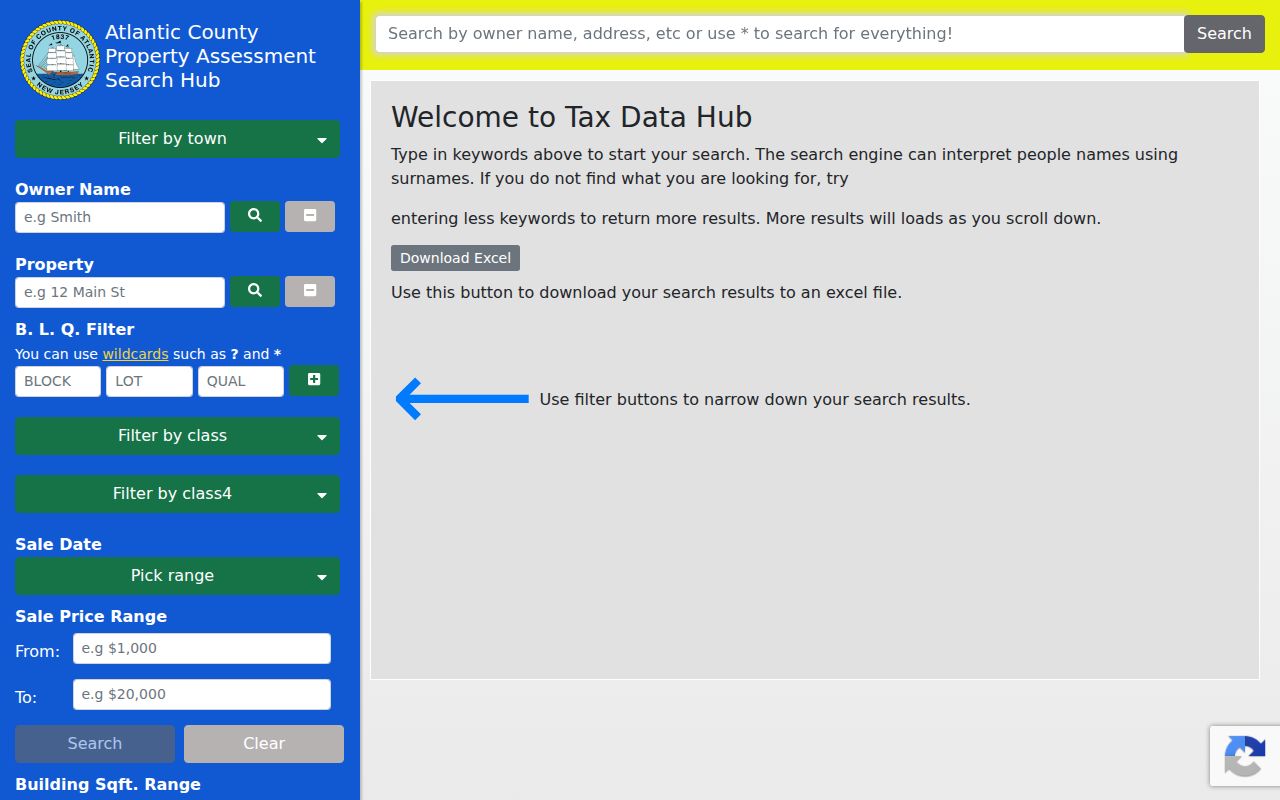
The screen confirms why a property search is useful for a name, a street address, or a block-and-lot clue, while the record still needs a second source for a residency conclusion.
Atlantic Clerk Name Trails
The Clerk's SearchNG environment is a strong name trail because it supports party, two-party, date, document-type or group, book-and-page, file-number, consideration, town, lot, block, and map-number searching. Party-name searching automatically wildcards names, and the instructions allow unlimited additional names, ALL or ANY name logic, two-party AND searching, and linked documents. Search both a formal spelling and a plausible spacing or hyphen variation. The county specifically warns that proper names can be entered inconsistently.
Document images are stated to begin March 1, 2000, with older images added through back-scanning. The online index can still point to a book, page, or file number when an image is absent. Search the grantee for an acquisition, then the seller as grantor for the earlier transfer. Linked mortgages, assignments, satisfactions, maps, and deeds can explain the sequence, but a lien or deed party is not automatically the current occupant.
- Roll
- A list created for an official purpose, such as an assessment list or registration file.
- Index
- A finding aid that points to a record; it may not include the record image.
- Parcel
- A mapped piece of land identified locally by block, lot, and sometimes qualification.
- Criss-cross directory
- A historical directory arranged by address, useful for tracing occupants rather than names.
Note: An image gap is an access gap, not proof that Atlantic County never recorded the underlying document.
Current Atlantic Resident Rolls
Current Atlantic residents appear in different record families because each one records a different relationship. The assessment roll is strongest for property ownership and parcel context. Voter records confirm a registration relationship for a matched person, subject to statutory limits. Deed indexes show parties to an instrument. Court and probate records supply context for a case or estate, rather than a complete people list. Use the source that answers the exact question, then verify rather than combining unlike records into a single claim.
| Atlantic source | What it can show | Custodian | Access path |
|---|---|---|---|
| Property assessment data | Owner, address, block/lot, assessment, and sales data | Board of Taxation and municipal assessor | County property hub or municipal route |
| Voter status | Registration-status confirmation for a matched voter | Superintendent of Elections | State portal or county office |
| Official Records index | Parties, document type, recording details, and linked records | Atlantic County Clerk | Free public index and records-room fallback |
| Case jacket | Parties, docket, case type, events, and attorneys | NJ Courts | Find a Case or court-record request |
| Local history sources | Year-specific households, newspapers, and obituaries | ACLS and Historical Society | Library, repository, or catalog route |
The Atlantic resident lookup is the better route when a single name must be checked across these different records without treating one list as conclusive.
Atlantic Voter Status Clues
New Jersey's official Voter Information Portal provides the “Am I Registered?” route. Atlantic's vote-by-mail guidance gives a useful warning: the name must match county records exactly. A surname such as McDonald may be filed as Mc Donald, and a marriage name change, middle initial, or nickname can cause a no-match. That makes alternate formal spellings worth trying before assuming the record is absent.
N.J.S.A. 19:31-39 describes a broader registration system, including name, registration address, municipality, ZIP, party affiliation when designated, registration date, and participation data. Public list copies exclude signatures, and protected home addresses are withheld under Daniel's Law. A voter result is not a household census, does not reveal how anyone voted, and does not resolve a disputed current address.
Atlantic Court Search Cards
The NJ Courts Find a Case page divides court searches by the problem being researched. It links separate surfaces for civil and foreclosure case jackets, criminal cases and judgments, judgment liens, tax cases, and municipal matters. The Atlantic/Cape May Vicinage handles Superior Court matters in this area, but a party's presence in a vicinage file does not establish where that person lives.
The public Case Jacket interface asks the researcher to select a case context and choose a party-name or docket route. For a party search it uses individual or business choice, last name, first name, optional middle initial, and a CAPTCHA. Two-character name searches are exact; three or more characters broaden the range. Public docket information can show a docket number, venue, case type, parties, attorneys, filings, orders, scheduled proceedings, and dispositions. Filed-document images and records restricted under Rule 1:38 require a separate request or remain closed.
NJ Courts Find a Case presents the distinct case-search cards used for Atlantic County research.
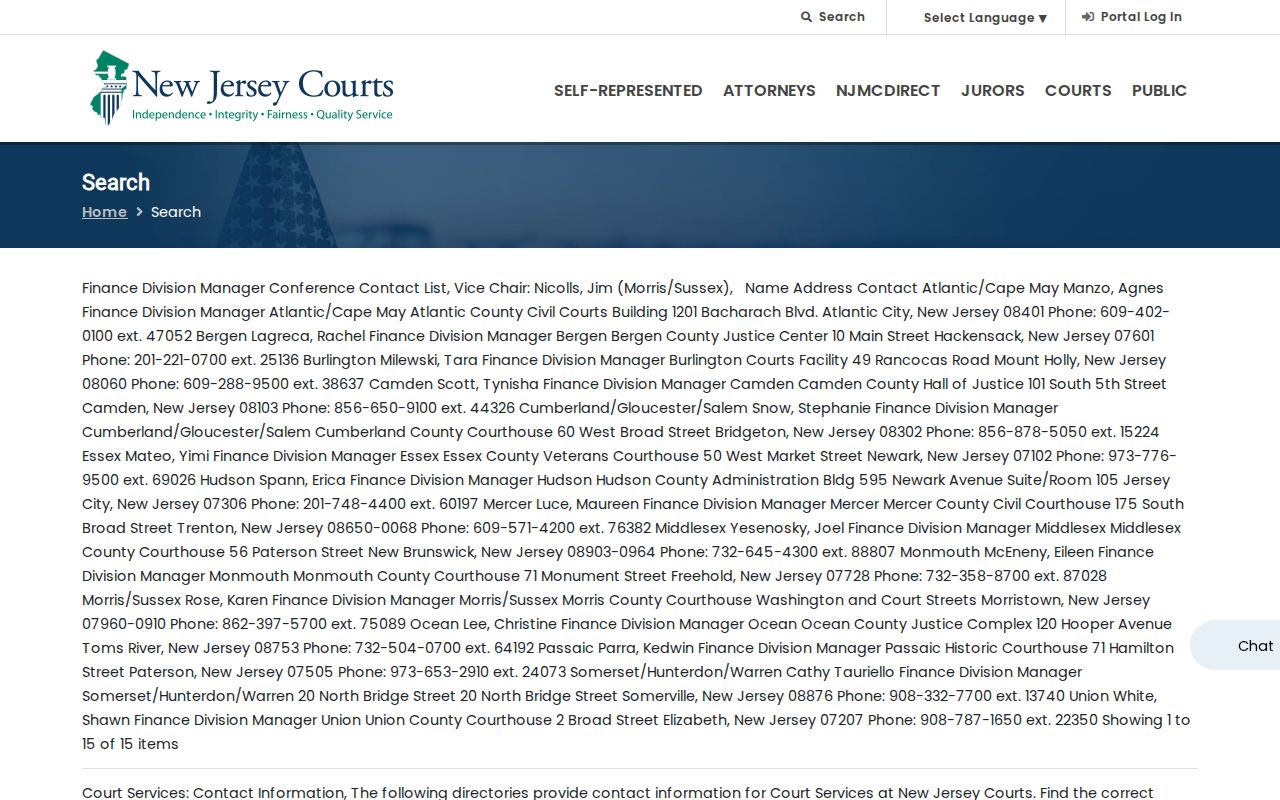
The court landing screen helps choose the right docket category before comparing dates, municipality, party role, and case type against another Atlantic record.
Atlantic Vital Record Windows
Vital records have a different access structure from an index. For an Atlantic County event, the local registrar in the municipality where it happened and the New Jersey Department of Health are the current custodians. State-held births start in 1925, and marriages and deaths start in 1951. The State Archives holds the older historical range. A name in a vital index can guide family research, but it is not the same thing as a certified copy.
New Jersey's genealogy windows are based on event type and age. Deceased-person birth records must be more than 80 years old and run through 1925; marriages must be more than 50 years old and run through 1951; deaths must be more than 40 years old and run through 1951. Certified copies require identity and a qualifying relationship, while informational certifications do not require relationship proof. The state research states a $25 initial genealogy search or record and $2 for an additional copy of the same record, with typical mail processing of 10 to 12 weeks.
New Jersey's genealogical-record page explains the identification, event-place, and year information requested from researchers.
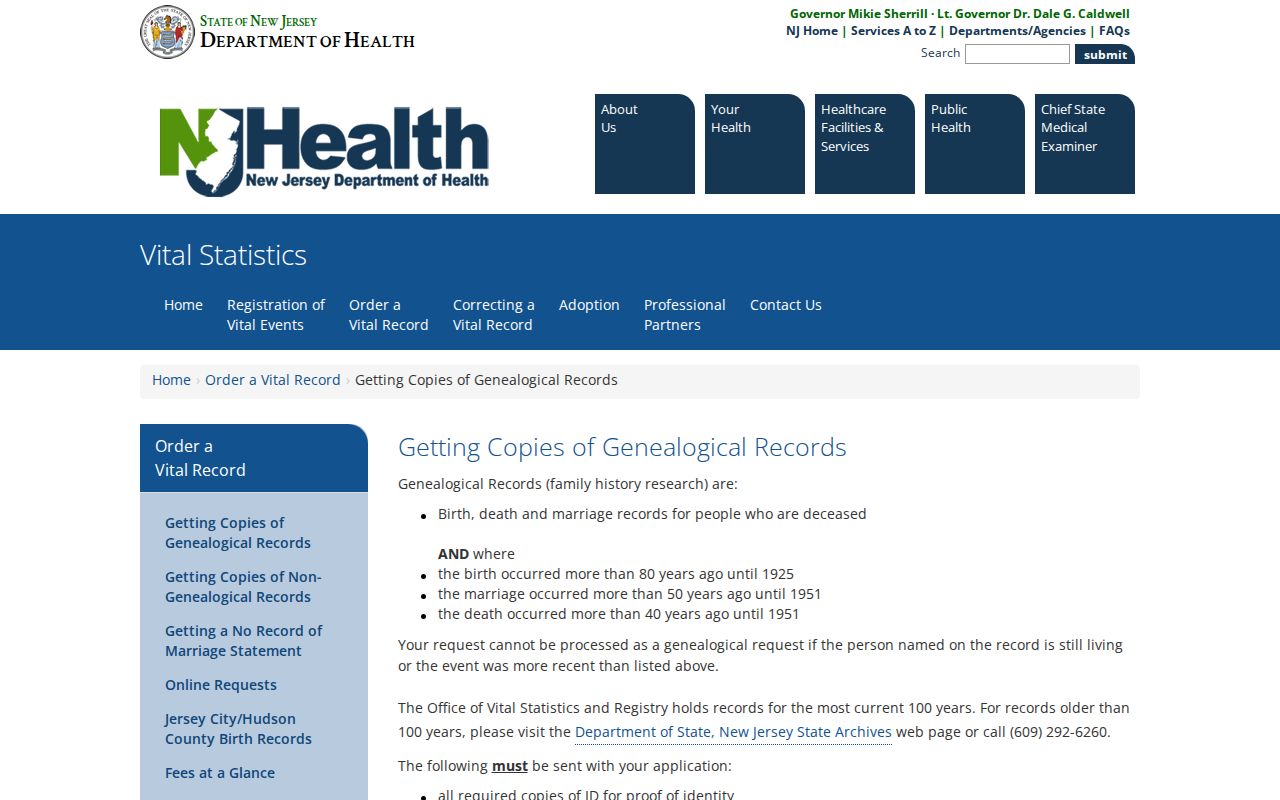
The application view underscores the difference between an historical family-research request and a request for a restricted certified copy.
Note: A negative vital-record search may reflect an eligibility window or a missing index, so use the State Archives and local repositories for the historical fallback.
Atlantic Probate and Obituary Trails
When a resident trail reaches a death or estate transition, the Atlantic County Surrogate can provide a different kind of evidence. The county states that completed probate files are available for public inspection. Wills, inventories, administrations, notices, short certificates, and estate filings can identify an executor, beneficiary, next of kin, or a notice address. Those facts can connect a surname to an estate, but they do not automatically prove ownership of a particular parcel.
Obituaries and newspapers add dates, relatives, funeral homes, cemeteries, churches, and sometimes an address. The Historical Society's newspaper holdings include 1859–1868 and 1905–1955, while ACLS offers digitized South Jersey papers from the 1860s, New York Times microfilm from 1851, and Atlantic City Press microfilm from 1981. Compare a probate file with a deed, tax map, or transfer before placing a household at a residence.
Atlantic Property Alert Limits
Atlantic County's free Property Alert service is a useful monitoring tool for a lawful property or estate interest. A person can register party names, including variants, or a municipality, block, and lot. The Clerk recommends party-name registration because parcel information is not present in every recorded instrument. More than one person can register the same name or parcel, and vacant land can be monitored.
The service does not stop a recording and does not confirm who occupies a property. The FAQ describes a 5 to 7 business day verification period before alerts are sent, and a matching recorded document may trigger an email after review. It is best treated as a notice that prompts a check of the original Clerk record, not as proof of ownership or a resident search result.
Note: Confirm an alert against the recorded instrument because an email match can be based on the registered name or parcel information alone.
Atlantic Records Privacy Boundaries
New Jersey Open Public Records Act, P.L. 2001, c.404, N.J.S.A. 47:1A-1 et seq., is a route to existing government records, subject to exemptions and privacy protections. A request should be written, signed, dated, specific, and sent to the named custodian. Electronic records are generally free apart from actual supplies, while special services can carry actual costs. The Government Records Council and Superior Court are the remedies named in the statute when a requester disputes access.
OPRA does not override Daniel's Law or the Address Confidentiality Program. Daniel's Law keeps eligible covered people's home addresses and unpublished telephone numbers out of government records and web postings. The Address Confidentiality Program provides a substitute address to eligible survivors of domestic violence, sexual assault, stalking, and similar safety threats. Sealed, expunged, juvenile, adoption, confidential family, and other protected court records also remain outside ordinary public searching.
| Official record route | Commercial directory category |
|---|---|
| Names the custodian, record date, and access limit; supports a request or correction route. | Can merge records from different dates and sources, may charge for access, and cannot correct the underlying public record. |
Atlantic Historical Resident Directories
Atlantic County's historical directory shelf is spread across the New Jersey State Library, Atlantic County Library System Resource Center, Atlantic County Historical Society, FamilySearch, and the State Archives. The State Library inventory identifies Gopsill's Atlantic City runs beginning in 1889, Crawford in 1899, C.E. Howe in 1908, and Boyd's in 1909–1910. Separate titles cover South Atlantic, West Atlantic, Longport, Margate, Pleasantville, and Ventnor, so a coastal title should not be assumed to cover every municipality.
Directories can preserve a household name, address, occupation, business, or a year-specific residence. They are especially helpful around the lost 1890 federal census, together with the 1885 New Jersey state census, newspapers, deeds, and church or cemetery sources. An address entry may describe a seasonal establishment or business, rather than a year-round residence. The Atlantic city directory has the collections, entry-reading method, and tracing steps in detail.
Atlantic's 1837 Records Geography
Atlantic County was carved from Gloucester County in February 1837, when the area was often called Egg Harbor. Mays Landing became the county seat in 1837, and the courthouse built in 1838 remains in use. That history matters because today's county has 23 incorporated municipalities, shore communities, inland townships, older place names, and postal labels that do not always describe the same geographic unit.
The Clerk's preservation work also explains why a historical trail may be partly online. Its SearchNG guidance reports completed work on more than 9,500 recorded maps and tax maps, all 414 index books, and Atlantic County Record newspaper material from 1864 to 1967. Deed-book scanning continues. Search the older county or place term when a modern municipality produces no useful result, then compare the municipality, block and lot, or historical map rather than relying on a street name alone.
Atlantic Library Catalog Changes
ACLS is an important resident-history stop because its Resource Center in the Mays Landing branch has reference specialists, public computers and scanners, Jerseyana and genealogy resources, federal and New Jersey census microfilm, newspapers, local-government material, and JerseyCat interlibrary loan. The library has also announced digitized South Jersey historical material and images of pre-Civil-War wills and letters of administration from the Atlantic County Clerk.
Atlantic County announced a Koha/Aspen catalog and mobile-app change in October 2025. Catalog labels and local-history search steps can therefore differ from older instructions. Search a surname, municipality, street, or directory title, then ask staff whether a reel, clipping file, yearbook, or digitized item has a different catalog path. The Historical Society in Somers Point adds family files, city directories, newspapers, church and cemetery records, school yearbooks, photographs, manuscripts, and oral histories.
Note: A repository's failure to find one name only means the searched collection did not produce a result, not that the person was absent from Atlantic County.